umati showcase specification

This provides the specification to connect to the umati showcase
PublishSubcribe (MQTT Transport and UA JSON encoding)
This page describe how to connect to the umati.app Dashboard by using PubSub instead of the server/client connection described in other parts of the Specification.
PubSub allows the distribution of data and events from an OPC UA information source to interested observers inside a device network as well as in IT and analytics cloud systems.
- Detailed Specification of PubSub can be found at: OPC 10000-14 Part 14: PubSub
- The JSON mapping is describe in Part14/7.2.3
Example Datasets
- MachineTool Examples:
Python Sample Publisher
A complete example of an OPC UA PubSub JSON publisher written in Python is available in the PubSub/Python-Publisher directory. It demonstrates how to publish OPC UA Part 14 JSON messages (ua-metadata and ua-data) directly to an MQTT broker following the umati conventions, without requiring a full OPC UA server.
Please refer to its Readme for details on:
- Message Structure (detailed explanation of
ua-metadataandua-datafields) - MQTT Topic Layout (the
opcua/umati/v3/json/...topic convention) - Configuration (how to configure an OPC UA Publisher to publish directly to the MQTT broker)
Details on the Encoding Strategy
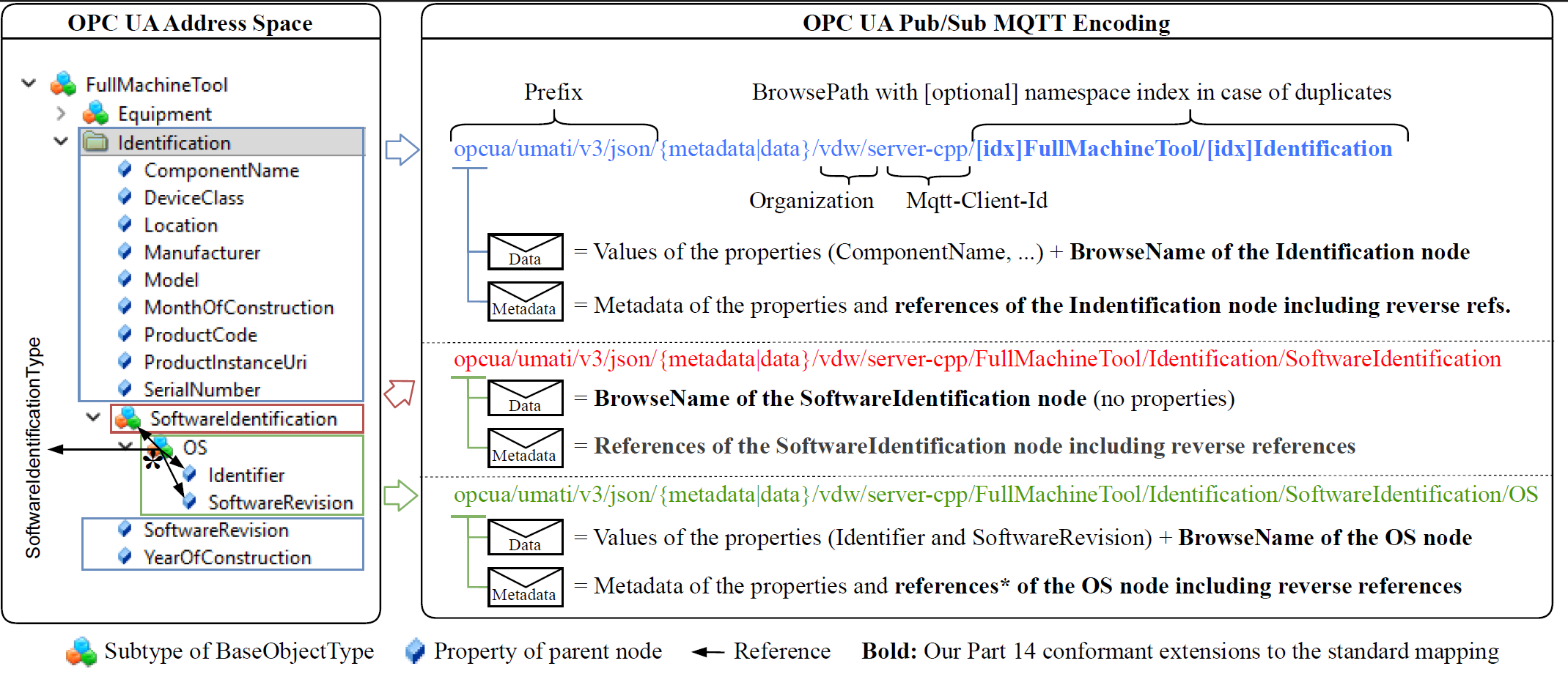
The idea of the showcase is to fully encode the address space into PubSub JSON messages and distribute them over mqtt. The mapping is constructed in such a way, that address space reconstruction is possible.
1. Overview
The encoding maps selected parts of an OPC UA AddressSpace to OPC UA PubSub messages transported via MQTT. The information is distributed between:
- MQTT topics, which represent the hierarchical BrowsePath,
- DataSetMetaData, which describes the DataSet and its fields and contains the encoded References,
- DataSetMessages, which contain the actual values and the
virtualId.
The following example represents the Identification node of a ShowcaseMachineTool.
2. MQTT Topic
The MQTT topic reflects the hierarchical position of the node:
opcua/umati/v3/json/data/vdw/server-cpp-dev/ShowcaseMachineTool/Identification
The relevant OPC UA path is therefore:
ShowcaseMachineTool
└── Identification
The topic identifies the DataSet to which the transmitted values belong. The semantic information itself is provided by the accompanying metadata message.
3. DataSetMessage
The DataSetMessage contains the current values of the fields of the Identification node.
The actual message is structured as follows:
Note: there are multiple encodings supported. We HIGHLY RECOMMEND the
verboseone. Thenon-verboseencoding is DEPRECATED.
Verbose:
{
  "MessageId": "bc919fec-a527-4278-be93-816d7070ced0",
  "MessageType": "ua-data",
  "PublisherId": "1",
  "Messages": [
    {
      "Payload": {
        "SerialNumber": {
          "UaType": 12,
          "Value": "2021-15360620311222485159"
        },
        "ProductInstanceUri": {
          "UaType": 12,
          "Value": "https://showcase.umati.org/Specs/Machinetools.html"
        },
        "Manufacturer": {
          "UaType": 21,
          "Value": {
            "Text": "umati Showcase"
          }
        },
        "YearOfConstruction": {
          "UaType": 5,
          "Value": 2021
        },
        "ProductCode": {
          "UaType": 12,
          "Value": "2653837gg1548"
        },
        "SoftwareRevision": {
          "UaType": 12,
          "Value": "v1.02.1"
        },
        "DeviceClass": {
          "UaType": 12,
          "Value": "Machining centre (other)"
        },
        "Location": {
          "UaType": 12,
          "Value": "EMO 6 A18/VIRTUAL 1 1/N 49.871215 E 8.654204"
        },
        "Model": {
          "UaType": 21,
          "Value": {
            "Text": "ShowcaseMachineTool"
          }
        },
        "virtualId": {
          "UaType": 12,
          "Value": "17:ShowcaseMachineTool.2:Identification"
        }
      }
    }
  ]
}
Non-verbose (DEPRECATED):
{
  "MessageId": "c0f3f803-835c-4f92-bd7c-40a268facb64",
  "MessageType": "ua-data",
  "PublisherId": "1",
  "Messages": [
    {
      "Payload": {
        "SerialNumber": "2021-15360620311222485159",
        "ProductInstanceUri": "https://showcase.umati.org/Specs/Machinetools.html",
        "Manufacturer": "umati Showcase",
        "YearOfConstruction": 2021,
        "ProductCode": "2653837gg1548",
        "SoftwareRevision": "v1.02.1",
        "DeviceClass": "Machining centre (other)",
        "Location": "CCMT 5 A219/GRIND 9 B20/VIRTUAL 1 1/N 49.871215 E 8.654204",
        "Model": "ShowcaseMachineTool",
        "virtualId": "17:ShowcaseMachineTool.2:Identification"
      }
    }
  ]
}
The values correspond to the fields defined in the metadata, such as SerialNumber, Manufacturer, YearOfConstruction, and SoftwareRevision.
virtualId
The additional virtualId field contains:
17:ShowcaseMachineTool.2:Identification
It encodes the BrowsePath of the node:
Namespace 17 → ShowcaseMachineTool → Namespace 2 → Identification
Thus, the virtualId allows the Subscriber to identify the node’s position independently of the MQTT topic.
4. DataSetMetaData
The corresponding metadata message uses:
MessageType = ua-metadata
PublisherId = 1
DataSetWriterId = 213
and identifies the DataSet using:
Name = ns=17;i=59008
This is the NodeId of the encoded Identification node.
The metadata additionally contains the NamespaceArray. This allows namespace indices used by NodeIds, BrowseNames, and the virtualId to be resolved to their namespace URIs.
5. Field Metadata
Every value transmitted in the DataSetMessage has a corresponding entry in MetaData.Fields.
For example:
SerialNumber
  BuiltInType = 12
  DataType.Id = 12
  ValueRank = -2
  DataSetFieldId = 47edff21-...

Manufacturer
  BuiltInType = 21
  DataType.Id = 21
  ValueRank = -2
  DataSetFieldId = 2cbc9a12-...

YearOfConstruction
  BuiltInType = 5
  DataType.Id = 5
  ValueRank = -2
  DataSetFieldId = d1723e1b-...
The metadata therefore provides the information required to interpret the values in the DataSetMessage rather than treating them as arbitrary JSON key-value pairs.
The same structure is provided for the remaining fields, including ProductCode, SoftwareRevision, DeviceClass, Location, and Model.
6. Encoding the AddressSpace Relations
The virtualId is a special DataSetField:
Name       = virtualId
BuiltInType = 12
DataType.Id = 12
In addition to the normal field information, this field contains a custom property:
Properties
└── relations
The relations property contains an array of encoded OPC UA References.
Each relation contains information such as:
ReferenceTypeId
IsForward
NodeId
BrowseName
DisplayName
NodeClass
TypeDefinition
For example, the Identification node has forward HasProperty references to:
Identification
├── HasProperty → SerialNumber
├── HasProperty → ProductInstanceUri
├── HasProperty → Manufacturer
├── HasProperty → YearOfConstruction
├── HasProperty → ProductCode
├── HasProperty → SoftwareRevision
├── HasProperty → DeviceClass
├── HasProperty → Location
└── HasProperty → Model
The corresponding references use
ReferenceTypeId = 46andIsForward = true.
7. Additional Type Relations
The relations array is not limited to hierarchical property relations.
For the Identification node, it also contains references to:
ShowcaseMachineTool
MachineToolIdentificationType
IMachineVendorNameplateType
IMachineTagNameplateType
ITagNameplateType
IMachineryItemVendorNameplateType
These references can use different ReferenceTypes and directions.
For example:
Identification
└── IsForward = false
    └── Reference → ShowcaseMachineTool
and:
Identification
└── IsForward = true
    └── Reference → MachineToolIdentificationType
This is important because the encoding preserves not only the parent-child structure but also type definitions and other non-hierarchical relationships.
8. Complete Encoding Flow
The encoding process for this example can therefore be described as:
OPC UA AddressSpace
        │
        │  Identify node and its relations
        ▼
Identification Node
        │
        ├── NodeId
        │     └── DataSetMetaData.Name
        │
        ├── BrowsePath
        │     └── DataSetMessage.virtualId
        │
        ├── Properties / Variables
        │     ├── DataSetMetaData.Fields
        │     └── DataSetMessage.Payload
        │
        ├── Data types
        │     └── DataSetMetaData.Fields
        │
        └── References
              └── virtualId.Properties.relations
The encoding works somewhat like this:
9. Reconstruction at the Subscriber
The Subscriber receives the DataSetMessage and the corresponding DataSetMetaData through MQTT.
The reconstruction works conceptually as follows:
- MQTT topic identifies the hierarchical data stream.
MetaData.Nameprovides the NodeId of the encoded node.MetaData.Fieldsdefines the structure and data types of the transmitted values.Payloadprovides the current values.virtualIdin the Payload provides the BrowsePath.virtualId.Properties.relationsprovides the References between the node and other OPC UA nodes.- The NamespaceArray resolves namespace indices used by the encoded identifiers.
- The Subscriber can combine these elements to reconstruct the semantic representation of the node.
The important aspect is that the Subscriber does not need to browse the original OPC UA AddressSpace. The required structural and semantic information is contained in the MQTT-based PubSub representation itself.